
MIG Pulse Welding Machine Manufacturers
Introduction / Quick Summary
Today's fabrication and manufacturing industries demand the highest levels of productivity while preserving full control of heat input, arc behavior, and weld appearance. MIG pulse welding machines, a class of sophisticated wire-feed welding equipment, operate by pulsed flow of controlled current to transfer molten metal from the welding wire to the work.
What to look for while comparing MIG Pulse Welding Machine Manufacturers? Pulse technology, Current range, Duty cycle, Wire size compatibility, Welding modes, Current control, Arc stability, Gas need, Material compatibility, Cooling, Protection features, Automation compatibility, Service support, Consumable availability.
What Is a MIG Pulse Welding Machine?
A MIG pulse welding machine is a type of gas-metal arc welding machine where a controlled pulsed current waveform governs the transfer of metal from a continuously fed wire electrode to the workpiece.
MIG is the abbreviation for the process Metal Inert Gas welding, but modern systems may use various types of other shielding gases depending on material and process. The welding wire is the electrode.
In pulse MIG, the power source maintains the current in pulsed mode. The goal is to transfer precise amounts of molten metal from the wire while keeping the arc during the lower-current part of the cycle.
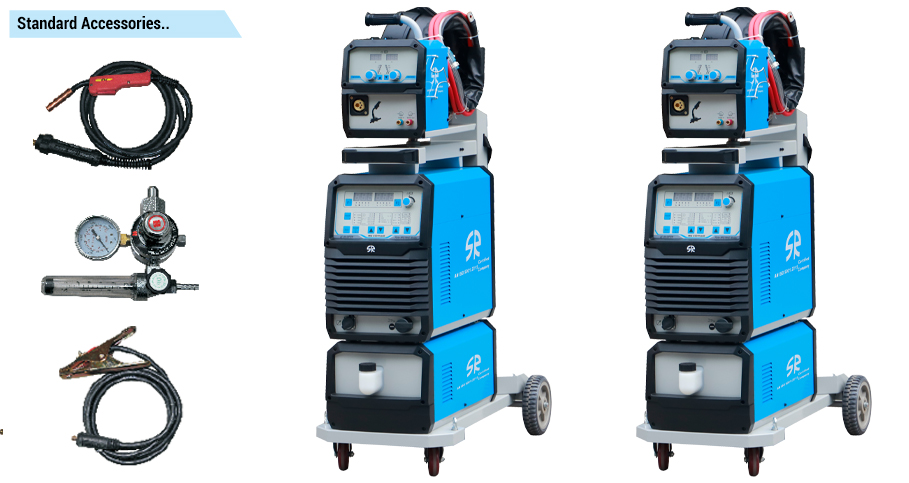
A typical MIG pulse system includes:
- Welding power source
- Inverter or electronic control system
- Wire-feed unit
- Welding torch
- Shielding-gas system
- Control panel
- Welding cables
- Earth cable
- Cooling system
- Digital parameter controls
- Welding software/control circuitry
Why MIG Pulse Welding Machines Matter
Pulse MIG technology can help in situations where a conventional MIG process fails to give the necessary balance of heat input, weld appearance, and efficiency.
1. Controlled Metal Transfer
A pulsed current controls the metal transfer as the molten metal moves from the wire to the workpiece.
2. Reduced Spatter
Correct pulse settings can decrease undesirable spatter compared with some conventional transfer modes.
3. Better Heat Control
Pulse welding offers control of heat input, which may be advantageous when welding thin sections or heat-sensitive applications.
4. Improved Weld Appearance
If pulse welding is properly set up, it can make very smooth welds that look consistent.
5. Suitable for Aluminium
The benefit of using Pulse MIG is that it is great for aluminium if the machine, wire, shielding gas, torch, and the parameters are all in harmony.
6. Suitable for Stainless Steel
Pulse control offers some useful benefits in heat management for certain stainless-steel welding operations.
7. Productivity
The continuous wire feeding will enable you to have long, uninterrupted runs of welding, unlike the MMA process where you would have to change electrodes regularly.
8. Automation Compatibility
The MIG pulse welding process could be adopted in semi- and fully mechanised and robotic welding systems where equipment exists to facilitate this.
How Does MIG Pulse Welding Work?
Step on a combination of continuous wire feed with switch-controlled electrical pulses.
1. Wire Feeding
The wire feeder feeds welding wire through the welding torch all the time.
2. Shielding Gas Supply
A shielding gas is channeled through the torch to shield the weld from the atmosphere.
3. Arc Initiation
The wire nears the workpiece, and an electric arc is formed.
4. Peak Current Pulse
The machine applies a high-current pulse of varying duration that pulls the molten droplet from the wire.
5. Background Current
Current falls to a lower level, keeping the arc.
6. Controlled Droplet Transfer
The process is repeated at a specified frequency, melting wire and depositing metal into the weld pool.
7. Torch Movement
The operator or system automatically extends the torch to follow the joint.
8. Weld Formation
The transferred liquid metal mixes with the base material, and they form the welded joint.
9. Cooling and Solidification
The heat from the welding torch radiates away, causing the weld pool to solidify, thereby producing the completed weld.
What Is Double-Pulse MIG Welding?
Double-pulse MIG welding is a variation of pulsed MIG welding, wherein the welding current or wire-feed characteristics are modulated by an additional low-frequency pulse wave during the main pulse cycle.
This can result in a more controlled and visually interesting weld pattern in appropriate situations.
SR Advantech's MIG-P series a IGBT module inverter double-pulse MIG welder. It claims that this double-pulse can achieve the beauty weld, and its square-wave/pulse-width technology is designed to achieve stable control of welding.
Double-pulse systems can be particularly useful for:
- Aluminium welding
- Stainless-steel fabrication
- Visible welds
- Precision fabrication
- Heat-sensitive applications
- Tags where weld appearance is significant
But of course, final weld quality is determined by material, wire, shielding gas, joint design, torch travel speed, parameter set selected, and skill of the operator-not just the presence or absence of pulse.
Specifications of MIG Pulse Welding Machines
| Specification | What to Consider |
|---|---|
| Input Voltage | Must match available electrical supply |
| Output Current | Determines welding capacity |
| Output Voltage | Influences arc characteristics |
| Current Range | Provides application flexibility |
| Duty Cycle | Important for production welding |
| Pulse Function | Determines controlled transfer capability |
| Double-Pulse Function | Useful for specific applications |
| Wire Diameter | Must match feeder and torch |
| Wire Feed Speed | Influences deposition rate |
| Welding Modes | Determines process flexibility |
| Shielding Gas | Must suit material and wire |
| Cooling System | Helps manage operating temperature |
| Digital Controls | Supports accurate parameter setting |
| Memory Functions | Useful for repeat production |
| Protection Features | Helps safeguard equipment |
| Dimensions | Important for installation |
| Weight | Relevant to machine movement |
| Automation Compatibility | Important for production integration |
Important Features to Look for in a MIG Pulse Welding Machine
Advanced Pulse Control
The key to reliable metal transfer is the ability to control the pulse current accurately and its timing.
Double-Pulse Function
A double-pulse function may prove useful for certain aluminum, stainless-steel, and appearance-sensitive applications.
Stable Wire Feeding
Continuous wire feeding is a must for a steady state of arc.
Accurate Voltage and Current Control
Independent control of welding parameters in a PSEE environment allows operators to adjust the parameters for various materials and thicknesses.
Digital Parameter Display
Digital controls may make installation easier and allow more consistency to be achieved during production.
Parameter Memory
The storage of welding parameters can also be advantageous when repeating production jobs. SR Advantech claims that its MIG-P machines can have a saving of up to 100 sets of customised parameter specifications.
Thermal Protection
Another less desirable option is to use either thermal protection to protect internal components against higher-than-rated temperatures or use forced airflow.
Input-Power Protection
Protection against low voltage, too high temperature, and surge of current is to protect the machine (which operating conditions are specified). The protection features below are listed by SR Advantech for the MIG-P series.
Suitable Wire-Feed System
The wire feeder should feed consistently and reliably for the diameter and material chosen.
Rugged Construction
Any industrial welding machine should be suitable for the working environment and production rate.
MIG Pulse Welding for Aluminium
Aluminium welding can be different from mild-steel welding due to the high thermal conductivity of the material, low melting temperature, and formed oxide layer that requires suitable process control.
Pulse MIG can have its advantages, as controlled metal transfer and heat input may aid the welding process.
Suitable equipment selection should consider:
- Aluminium wire
- Appropriate wire diameter
- Shielding gas
- Spool or wire-feeding arrangement
- Torch liner
- Contact tip
- Welding current
- Pulse parameters
- Travel speed
- Joint design
- Material thickness
SR Advantech has explicitly claimed that the MIG-P series is for the welding of aluminium, stainless steel and copper, with double-pulse technology targeted at aluminium welding.
MIG Pulse Welding for Stainless Steel
Welding of stainless steels needs to be carefully controlled for heat input and shielding conditions.
Pulse MIG can be a service to regulated metal transfer and can be suitable for some stainless steel fabrication processes.
Important considerations include:
- Stainless-steel wire selection
- Appropriate shielding gas
- Wire diameter
- Pulse settings
- Welding current
- Arc length
- Travel speed
- Joint configuration
- Heat input
- Surface preparation
It should always be set up using the applicable welding procedure and material specification.
MIG Pulse vs Conventional MIG Welding
| Feature | MIG Pulse | Conventional MIG |
|---|---|---|
| Metal Transfer | Controlled pulsed transfer | Depends on selected transfer mode |
| Heat Control | Generally better controlled | Depends on settings |
| Spatter | Can be reduced with suitable settings | Can be higher in some modes |
| Weld Appearance | Often smoother | Depends on process |
| Aluminium | Highly suitable for appropriate applications | Also possible |
| Stainless Steel | Suitable | Suitable |
| Equipment Cost | Generally higher | Generally lower |
| Parameter Complexity | Higher | Comparatively simpler |
| Automation | Excellent | Excellent |
| Production Use | High | High |
MIG Pulse vs TIG Welding
| Feature | MIG Pulse | TIG |
|---|---|---|
| Electrode | Consumable wire | Non-consumable tungsten |
| Filler | Continuous wire | Separate filler or autogenous |
| Welding Speed | Generally higher | Generally slower |
| Heat Control | Good with pulse technology | Excellent |
| Precision | High | Very high |
| Productivity | High | Lower for long production welds |
| Aluminium | Suitable | Excellent |
| Stainless Steel | Suitable | Excellent |
| Automation | Highly suitable | Highly suitable |
| Operator Skill | Important | Highly important |
Why Choose SR Advantech Systems?
Among MIG Pulse Welding Machine Manufacturers, SR Advantech Systems has good experience in welding machines and different welding technologies.
Established in 1992
Founded in 1992, SR Advantech Systems was formed by a group of electrical, electronics, and mechanical engineers who had gained extensive experience within the welding industry. They started up with a service for welding machines.
Experience in Welding Equipment Manufacturing
The history of manufacturing that has taken place within the company features a 1200 A submerged ARC welding machine, for use under the industrial conditions existing in India. According to SR Advantech, the first machine of this type was commissioned back in 1993, at an LPG-cylinder manufacturing factory.
Broad Welding Portfolio
SR Advantech's product portfolio covers:
- ARC/MMA welding machines
- TIG welding machines
- MIG welding machines
- MIG pulse welding machines
- Aluminium welding machines
- Plasma cutting machines
- Stud welding machines
- Submerged ARC welding
- Welding rectifiers
- Welding transformers
- Portable CNC plasma cutting machines
- Gantry cutting machines
- MIG/CO2 welding machines
- Welding spares and accessories
Customers can compare various welding technologies according to their application.
Certifications and Quality Considerations
Documentation of good quality must be checked during the purchase of industrial welding equipment.
According to the published product documentation of SR Advantech, the company is an ISO 9001:2015 company.
Before purchasing a MIG pulse welding machine, businesses should review:
- Product technical datasheet
- Input electrical specifications
- Output-current range
- Output-voltage range
- Duty-cycle information
- Pulse-mode specifications
- Wire-feed specifications
- Applicable welding-equipment standards
- Quality-control documentation
- Product-specific compliance certificates
- Warranty terms
- Operating manual
- Installation requirements
- Maintenance instructions
- Spare-parts availability
- Technical-support arrangements
Real Use Cases and Industries
MIG pulse welding machines for a wide range of industrial uses requiring a controlled wire-feed welding process.
1. Aluminium Fabrication
Pulse MIG is very effective for appropriate aluminium parts, structures, frames and assemblies.
2. Automotive Manufacturing
Automotive manufacturers can utilize pulse MIG technology on components and assemblies where control of heat input and repeatability are important.
3. Auto Component Manufacturing
Component manufacturers interested in repeat production of compatible Aluminium & Steel components can utilize pulse welding.
4. Stainless-Steel Fabrication
Can be used for appropriate stainless-steel fabrication tasks where aesthetics and controlling heat are a concern.
5. Machinery Manufacturing
Lightweight MIG pulse systems can also be utilized by machinery manufacturers for: frames, housings, brackets and supports, or other fabricated parts.
6. Engineering Industries
Manufacturing companies could utilize pulse MIG technologies to produce bespoke and repeat production metal parts.
7. Electrical Equipment Manufacturing
Fittings-including enclosures, cabinets, frames, and fabricated parts-can be welded with the appropriate system.
8. Industrial Equipment
For appropriate structures or assemblies, manufacturers of industrial equipment may employ MIG pulse welding.
9. Sheet-Metal Fabrication
Pulse MIG is only beneficial for some sheet-metal tasks that require tight heat input control and a tidy weld appearance.
10. Precision Fabrication
If weld quality, repeatability, and controlled heat input are a concern, then pulse technology can be a useful addition to provide process flexibility.
How to Choose the Right MIG Pulse Welding Machine
Identify the Materials
Will the machine be used mostly for welding aluminium, stainless steel, mild steel, copper, or some other material?
Determine Material Thickness
Determine the thickness range that is to be welded regularly.
Select the Appropriate Wire
The wire material and diameter are to be identical to the base metal and the welding procedure.
Determine Shielding Gas
Select the suitable gas or mixture of gases applicable in terms of the material and welding process.
Evaluate Current Capacity
Choose a machine with a suitable current range to perform the expected tasks.
Check Duty Cycle
Duty cycle at the actual operating current should be considered for production welding.
Consider Pulse Modes
Check if you need single pulse, double pulse, or other pulse function.
Evaluate Parameter Memory
For repeat production, stored welding programs can be used to reduce set-up time and maintain quality.
Check Wire Feeder
Stable welding cannot be done without a reliable wire-feed device.
Evaluate Torch Configuration
The torch should be compatible with the material, wire, current, and duty cycle.
Consider Cooling
Check if the equipment needs cooling by air or liquid, and verify that this can be provided within the premises.
Evaluate Service Support
Availability of spare parts, torch parts, wire feed parts, consumables, and technical assistance.
MIG Pulse Welding Machine Supply Across India
SR Advantech Systems: Jandikunta (Jeedimetla), Hyderabad, Telangana. It has emerged from a welding-machine service organisation to a manufacturer of welding and cutting equipment.
Its broader product portfolio includes:
- MIG pulse welding machines
- Conventional MIG welding machines
- ARC/MMA welding machines
- TIG welding machines
- Aluminium welding machines
- Submerged ARC welding machines
- Stud welding machines
- Welding rectifiers
- Welding transformers
- Plasma cutting machines
- Portable CNC plasma cutting machines
- Gantry cutting machines
- MIG/CO2 welding machines
- Welding spares and accessories
With MIG pulse equipment, customers in Hyderabad, Telangana, Andhra Pradesh, Karnataka, Tamil Nadu, Maharashtra, and other industrial areas in India can test their materials, thickness, production rate, welding process, and automation needs.
Conclusion
MIG pulse welding machines offer a sophisticated technology for manufacturers requiring: controlled metal transfer, more efficient heat management, reduced spatter, high productivity, and the best possible weld appearance in the right applications. The technology is especially suited to aluminium, stainless steel, and other applications where normal MIG operating parameters cannot deliver a good balance of control and finish.
Please feel free to contact us for any requirements for MIG Pulse Welding Machine Manufacturers. Please discuss with us your material and thickness and wire needs, shielding gas, welding current, duty cycle, production and automation needs, and we will help you find the correct MIG pulse welding solution.
Other Recommendations: TIG WELDING MACHINE MANUFACTURERS IN INDIA